
What Is a Bishop Score? Understanding Your Chances of a Successful Induction

"You're about 2 centimeters dilated and your Bishop Score is a 7.
If your provider has ever said something like that, you probably nodded politely while secretly wondering...
"A Bishop what?"
You're not alone.
As a birth doula, I've learned that one of the biggest reasons parents feel anxious is because they're making decisions with information they don't fully understand. Medical providers use terms every day that are completely normal to them—but completely new to most parents.
The Bishop Score is one of those terms.
The good news? It's actually a pretty simple tool.
And understanding it can help you ask better questions, make more informed decisions, and walk into an induction feeling far more confident.
Because confidence doesn't come from knowing exactly how birth will unfold.
It comes from understanding what's happening and why.
What Is a Bishop Score?
A Bishop Score is a scoring system providers use to estimate how ready your cervix is for labor.
Think of it like checking whether the "front door" is beginning to open before trying to invite labor in.
It doesn't predict exactly how your birth will go.
It doesn't guarantee success or failure.
Instead, it helps estimate how likely an induction of labor is to work using your cervix's current condition.
Generally speaking:
A higher Bishop Score often means your cervix is already preparing for labor.
A lower Bishop Score usually means your cervix may benefit from cervical ripening before induction begins.
It's one piece of the puzzle—not the entire picture.
What Does the Bishop Score Measure?
Your provider evaluates five characteristics during a cervical exam.
1. Dilation
How open is your cervix?
Measured in centimeters from:
Closed
1–2 cm
3–4 cm
5+ cm
Remember, dilation by itself doesn't tell the whole story.
Many moms walk around at 2–3 centimeters for weeks before labor begins.
2. Effacement
How thin is the cervix?
During pregnancy the cervix is thick and firm.
As labor approaches, it gradually softens and thins.
Think of it like pulling a turtleneck sweater over your head—the opening stretches and becomes thinner.
3. Baby's Station
Where is your baby's head in relation to your pelvis?
A baby sitting lower in the pelvis often means labor is progressing toward birth.
Higher numbers (closer to birth) generally contribute to a higher Bishop Score.
4. Cervical Position
During pregnancy, the cervix often points toward your back.
As labor approaches, it gradually moves forward.
Your provider may describe it as:
Posterior
Mid-position
Anterior
Again, another sign that your body is getting ready.
5. Cervical Consistency
How does the cervix feel?
Providers describe it as:
Firm
Medium
Soft
A softer cervix generally responds better to induction.
What Is Considered a "Good" Bishop Score?
Although every provider is slightly different, here's a general guideline.
Bishop ScoreWhat It May Mean0–5Cervix likely needs ripening first6–7Becoming more favorable8+Often considered favorable for induction
A higher score generally increases the chances of a successful induction, but it doesn't guarantee a straightforward labor.
Likewise, a lower score doesn't mean an induction will fail. It simply means your provider may recommend helping your cervix prepare before moving on to contractions with medications like Pitocin.
Does a Low Bishop Score Mean I'll Need a C-Section?
Absolutely not.
This is one of the biggest misconceptions I hear.
A lower Bishop Score simply means your cervix isn't quite as ready yet.
Many parents with low scores go on to have beautiful vaginal births after cervical ripening.
The important thing is recognizing that induction may take longer.
Sometimes much longer.
Instead of expecting labor to happen in a few hours, it's helpful to mentally prepare for the possibility that induction is a process rather than a single event.
One of the greatest gifts you can give yourself is realistic expectations.
How Can Your Provider Help Ripen the Cervix?
If your Bishop Score is low, your provider may recommend cervical ripening before starting medications that stimulate contractions.
Common methods include:
Cervical Ripening Balloon (Foley or Cook Catheter)
A small balloon gently encourages the cervix to open.
Cervidil
A medication placed near the cervix that slowly releases prostaglandins to soften it.
Cytotec (Misoprostol)
A medication sometimes given orally or vaginally to help prepare the cervix.
Each option has its own benefits, risks, and considerations. Your provider can help determine which approach is appropriate for your situation.
Can You Improve Your Bishop Score Naturally?
This is where the internet gets a little...creative.
You've probably seen suggestions like:
Eat dates
Drink raspberry leaf tea
Walk for miles
Bounce endlessly on a birth ball
Eat spicy food
Schedule your induction so the baby gets nervous. (Okay...that one isn't real.)
The truth?
Although there is evidence on things you can do that will help ripen your cervix over time, there isn't strong evidence that any one trick reliably changes your Bishop Score overnight.
What can help is preparing your body throughout pregnancy for optimal movement and alignment.
This is one reason I love incorporating Body Ready Method® principles with my doula clients. Supporting balance, mobility, and baby-friendly positioning may help your body function more efficiently as labor approaches. While no exercise can guarantee a higher Bishop Score or spontaneous labor, improving comfort, movement, and pelvic balance can be valuable preparation for birth.
Questions to Ask Before an Induction
Understanding your Bishop Score gives you a great starting point, but don't stop there.
Consider asking:
What is my Bishop Score today?
Which parts of my score are lowering it?
Do you recommend cervical ripening first?
What induction methods are available?
How long should I expect this process to take?
At what point would you consider the induction unsuccessful?
What happens if my body doesn't respond as expected?
These questions can help you understand the plan and participate in decisions along the way.
Knowledge Creates Confidence
One of my favorite parts of supporting families is watching fear shrink as understanding grows.
I've had clients hear "Your Bishop Score is only a 3" and immediately assume something is wrong.
In reality, it simply means their body may need a little more time and support before active labor begins.
Birth isn't a test you either pass or fail.
A score doesn't define your body, your baby, or your ability to give birth.
It's simply one tool your provider uses to help make thoughtful medical decisions.
The more you understand those tools, the more confident you'll feel asking questions and making choices that align with your values.
And that confidence? It serves you no matter how your birth unfolds.
Continue Learning
If you're preparing for an induction, these resources will help you feel even more prepared:
The Truth About Induction: What Every Twin Cities Mom Should Know
Why Confidence Matters More Than Having a Birth Plan
Childbirth Education Classes – Learn what interventions are, when they're recommended, and how to make informed decisions before labor begins.
Birth Coaching – Want personalized guidance as you prepare for birth? Birth coaching can help you create a plan, understand your options, and feel confident going into labor—even if you're planning an induction.
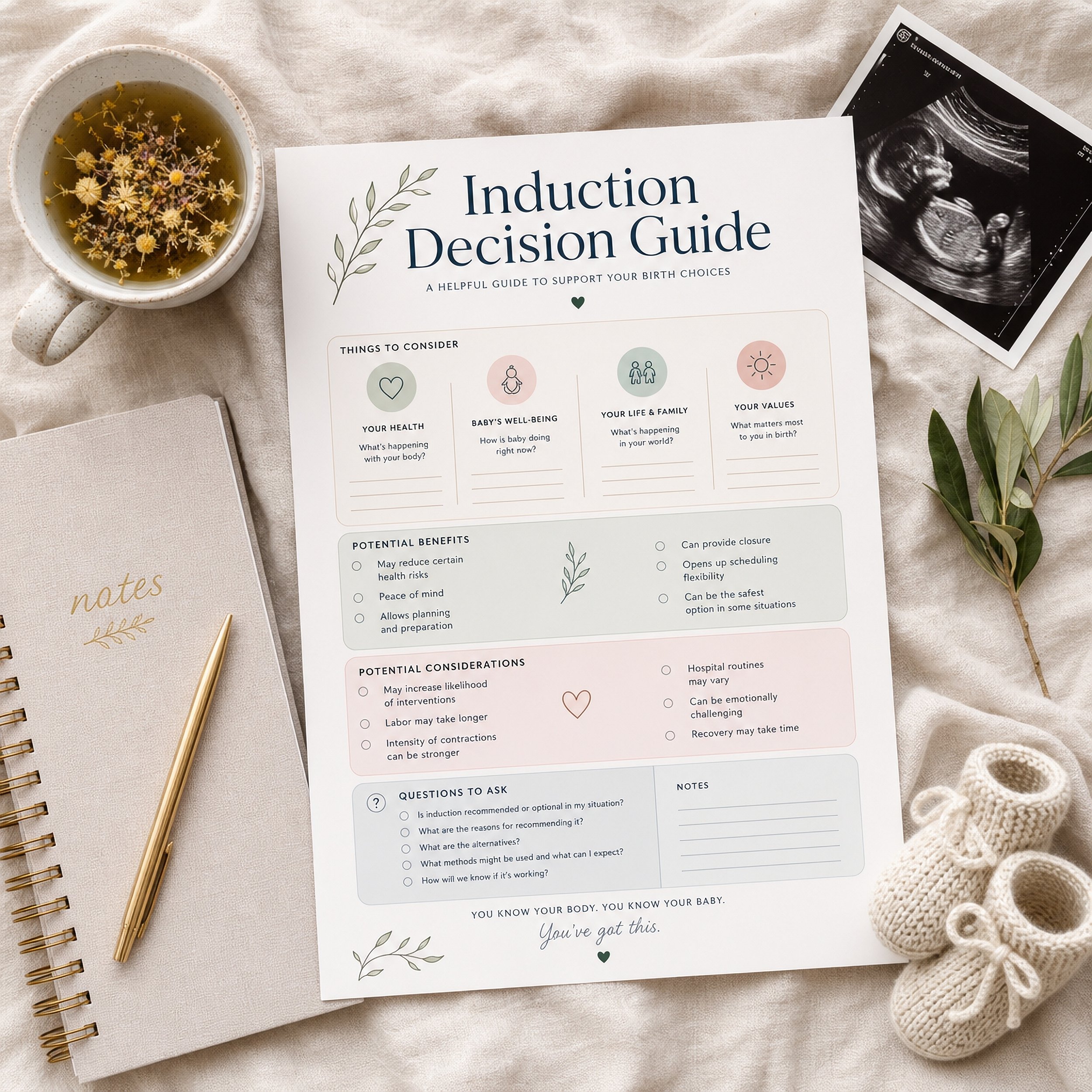
Free Resource
Induction Decision Guide
Not sure what to ask when induction comes up?
Download my free Induction Decision Guide to help you:
Understand your options
Know the right questions to ask
Learn common induction methods
Feel confident making informed decisions
Feeling Like Induction Language Is a Foreign Language?
If terms like Bishop Score, Pitocin, Cervidil, or Foley balloon make your head spin, you're not alone.
That's exactly why I created my Free Induction Guide—a simple, evidence-based resource to help you understand your options before you're making decisions in the middle of labor.
Inside you'll find:
What the most common induction methods are
When they're typically used
Benefits and risks to know
Questions to ask your provider
Simple ways to prepare your body if there's time
If you'd like to dive even deeper, my Confident Mama Childbirth Education Course walks you through induction, labor, medical interventions, comfort measures, and how to make informed decisions with confidence—so you feel prepared no matter how your birth unfolds.
And if you're looking for personalized support, I'd love to come alongside you as your Twin Cities birth doula or birth coach. My goal isn't to tell you what decisions to make—it's to help you understand your options so you can make them with confidence.
Explore my Birth Doula Services →
About the Author
Terri Schelkoph, CD(DONA), HCHD, is the founder of Confident Mama and an experienced Twin Cities birth doula, childbirth educator, and birth coach. Since 2018, she has supported more than 350 families through pregnancy, labor, and birth. Terri is a Body Ready Method® Certified Professional, VBAC Link® Certified Doula, and Hypnobabies® Certified Hypno-Doula, with additional training through Spinning Babies®.
Through Confident Mama, Terri provides practical, evidence-informed childbirth education designed to help parents prepare with intention, understand their options, and approach birth feeling informed and confident.